- Eight regional traditions
- UNESCO-recognised wayang
- Language and story guidance
- Respectful viewing etiquette
There is no single form called Indonesian theatre
Indonesia's theatre arts are a network of living regional traditions rather than one national stage style. A performance may combine spoken drama, sung narrative, dance, martial movement, puppetry, masks, comedy, music, ritual context, or audience interaction. The language, story, instruments, costumes, and relationship between actor and spectator can change completely from Jakarta to West Sumatra, Central Java, East Java, South Sumatra, or Bali.
For travellers, this variety is the attraction and the challenge. A visitor who expects a translated, two-hour indoor play may instead find an open-air community event in a regional language, a condensed tourist performance, or an all-night wayang programme. The most rewarding approach is to learn the basic form, check the exact production, and let the local performance conventions lead the experience.
The eight traditions below are a starting map, not a complete catalogue. Indonesia's cultural authorities recorded hundreds of intangible-heritage elements in the performing-arts domain by 2022, and many more practices continue through communities, schools, festivals, palaces, arts centres, and independent groups. A short guide cannot represent every local variant or the knowledge held by its practitioners.
1. Wayang kulit and wayang golek: theatre through puppetry
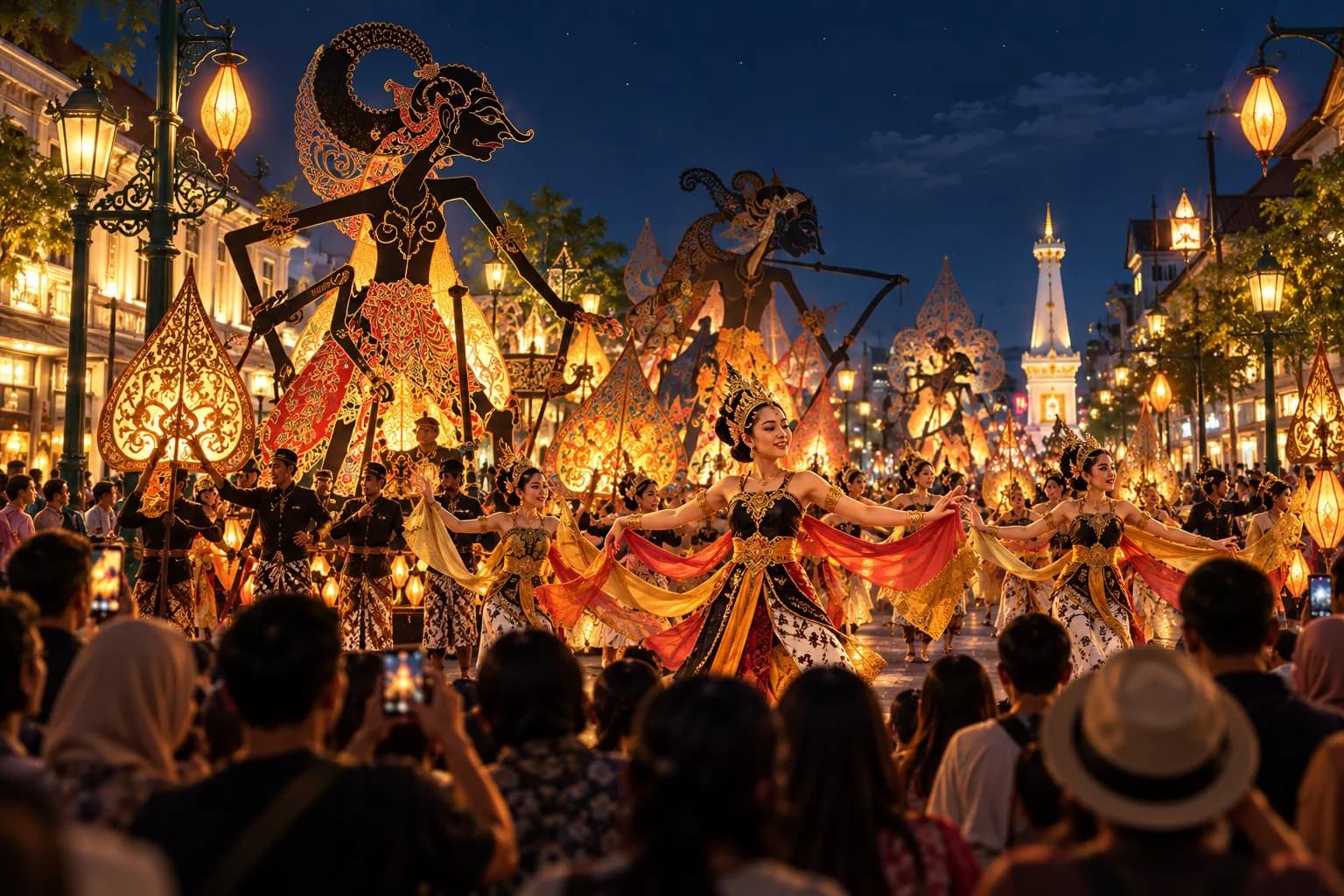
Wayang is Indonesia's best-known theatrical storytelling tradition and one of its most varied. UNESCO inscribed Wayang puppet theatre on the Representative List of the Intangible Cultural Heritage of Humanity in 2008, following its proclamation as a Masterpiece in 2003. UNESCO describes a tradition that developed in Java, flourished in courts and rural communities, and spread to Bali, Lombok, Madura, Sumatra, Borneo, and other regions in distinct local forms.
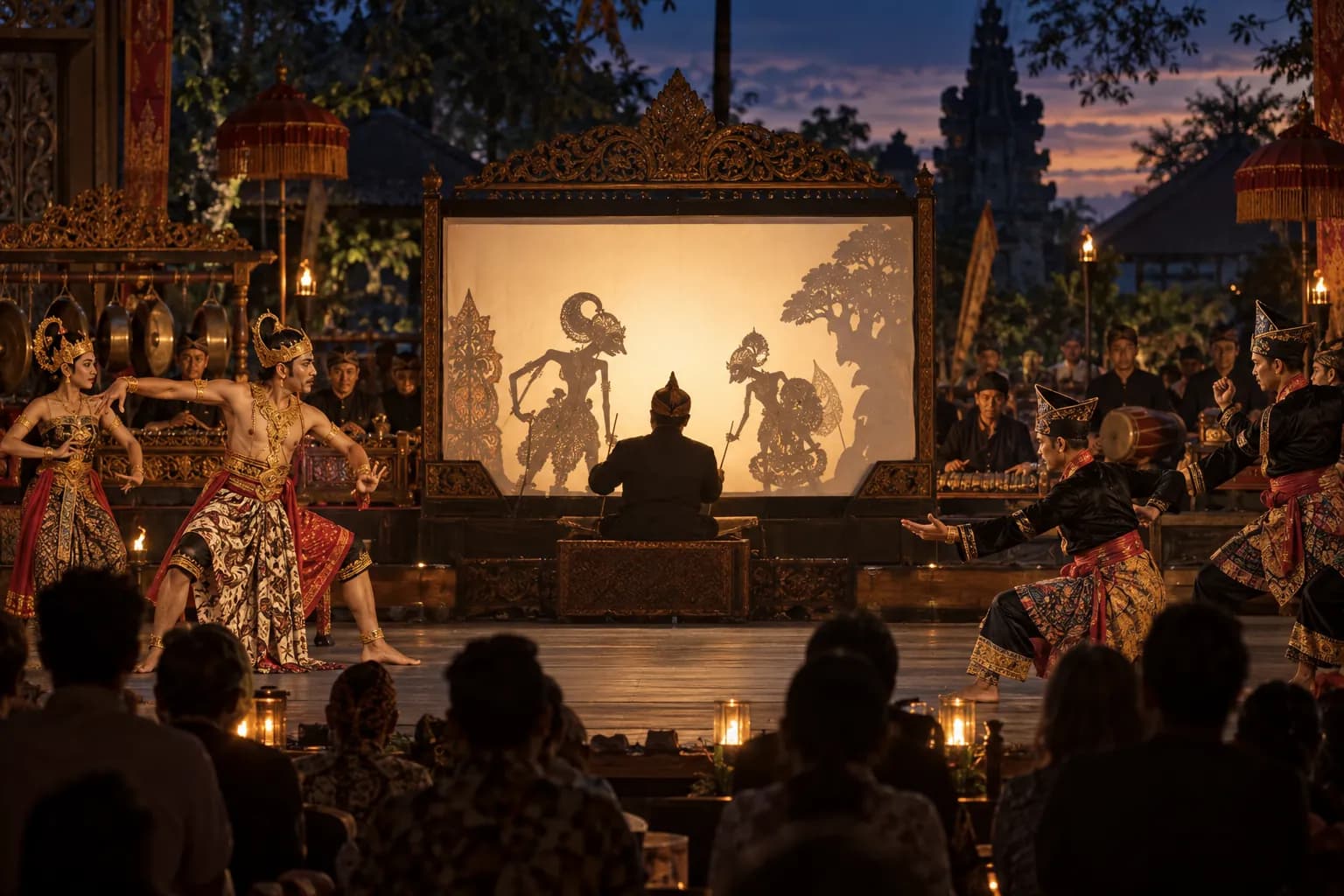
Wayang kulit uses flat, intricately cut leather puppets associated with a lit screen and shadow image. Wayang golek uses three-dimensional wooden puppets and is strongly associated with Sundanese performance in West Java. A dalang does far more than move figures: the puppeteer directs the narrative, voices characters, shapes rhythm and humour, and works with singers and musicians. Stories may draw on the Ramayana and Mahabharata while being reinterpreted through local philosophy, social concerns, and comic interludes.
Before attending, ask which side of the screen the audience uses, whether the programme is a full traditional duration or a shortened presentation, and whether a synopsis is available. Watching the dalang and musicians can be as revealing as watching the shadows. Do not handle a puppet, instrument, or offering without permission; these are not merely decorative props.
2. Wayang wong or wayang orang: epic characters embodied by actors
Wayang wong—also written wayang orang—moves wayang narratives into live theatre. Actors use codified gesture, dance, dialogue, costume, makeup, and gamelan to embody heroes, rulers, servants, giants, and comic characters. The form makes the visual world of wayang physical while keeping its relationship with epic stories, moral choices, courtly aesthetics, and locally interpreted characters.
The Indonesian cultural authority includes Wayang Orang among the country's many wayang forms, while official tourism information identifies performances in Yogyakarta and at Wayang Orang Sriwedari in Surakarta. Schedules, subtitles, duration, and language can change, so check the venue directly rather than relying on an old itinerary. A tourist-oriented excerpt and a repertory performance may tell similar stories but offer different pacing and depth.
A plot summary helps enormously. Learn the central characters and conflict before arrival, then watch how status is expressed through stance, gaze, hand position, pace, costume, and vocal register. Even without understanding every Javanese line, an informed viewer can follow alliances, confrontation, humour, and changes in power.
3. Ketoprak: Javanese history, legend, and popular drama
Ketoprak is a live-actor Javanese theatre form built around stories from history, legend, and folklore. Indonesia's tourism portal describes performances using Javanese dialogue with gamelan accompaniment. Productions can combine courtly conflict, romance, political manoeuvring, family duty, humour, and moral consequence, with style varying between community stages and professional venues.
Do not confuse ketoprak theatre with ketoprak, the Jakarta food of rice cake, tofu, noodles, peanut sauce, and other ingredients. Search with terms such as 'ketoprak theatre', 'kethoprak performance', the city, and the date. The alternative spelling kethoprak is common and useful when looking at programmes in Yogyakarta or Central Java.
Language carries much of the form's character. Different levels of Javanese speech can signal age, intimacy, rank, respect, or conflict, while comic scenes may respond to contemporary life. If no subtitles are available, read the synopsis and listen for changes in rhythm and register rather than expecting a word-for-word understanding.
4. Lenong: Betawi humour and social commentary
Lenong belongs to Betawi culture in Jakarta and its surrounding cultural landscape. Indonesia's official tourism portal describes a theatre of humour, satire, social commentary, spontaneous dialogue, and gambang kromong accompaniment. Improvisation helps performers connect a familiar story with the audience and with issues that feel current in the room.
The same official source distinguishes Lenong Denes, associated with royal and heroic stories, from Lenong Preman, which concentrates more on ordinary community life and tends towards a lighter, more direct comic style. These labels are helpful, but the exact language, music, cast, and structure still depend on the group and occasion.
Betawi speech and local references can make lenong difficult for a newcomer to translate in real time. Watch how the actors address one another and the audience, how music marks an entrance or mood, and how laughter changes the timing. Ask before recording: an informal-looking community performance is still creative work, and performers or organisers may set limits on video.
5. Ludruk: East Javanese popular theatre
Ludruk is a traditional theatre form from East Java with a strong connection to popular audiences. It is widely associated with everyday social life, direct humour, music, dance, and stories that can carry criticism or public messages. Indonesia's Directorate General of Culture has documented ludruk being used to communicate the country's cultural-advancement law, illustrating the form's continuing role as more than historical display.
A ludruk programme may rely heavily on East Javanese language, comic timing, and shared references. That should not be treated as a flaw to be removed for visitors. Read whatever synopsis is available, recognise that the home audience may hear layers you do not, and pay attention to the relationship between opening material, comic exchanges, songs, and the central drama.
Look for verified programmes in Surabaya and elsewhere in East Java through cultural offices, recognised arts venues, festivals, or the performing group itself. Do not assume that a blog's weekly schedule remains current. Community ensembles may perform for particular events rather than operate like a permanent commercial attraction.
6. Randai: Minangkabau theatre in a circle
Randai comes from Minangkabau culture in West Sumatra. Official Indonesian tourism information describes an ensemble form that combines drama, music, dance, singing, and movement influenced by silat. Performers commonly work in a circle, creating a theatrical space that can feel communal rather than divided into a conventional raised stage and silent auditorium.
Stories often draw on Minangkabau legend or history and carry moral and cultural meaning. The circular formation, rhythmic movement, sung passages, dialogue, and martial vocabulary are not separate attractions pasted together; they cooperate to tell the story and establish the group's energy. The audience's proximity can make small changes in timing and response especially visible.
A visitor should avoid stepping into the playing circle, blocking sightlines, or moving around for photographs during a quiet scene. Confirm whether the presentation belongs to a festival, community celebration, educational event, or ticketed theatre programme, because the host's expectations may differ. Ask about seating and clothing when the performance is connected to a formal cultural occasion.
7. Dul Muluk: Palembang's theatre of story, music, and oral literature
Dul Muluk is a traditional theatre form associated with Palembang and South Sumatra. Indonesia's tourism portal traces its development to the nineteenth century and describes a combination of drama, music, and oral literature in Palembang Malay. Its source material includes stories with Middle Eastern roots that were adapted into a local performance world.
Performances use costume, music, humour, and moral storytelling, and the form has appeared at celebrations, cultural programmes, and educational preservation activities. Its history is a reminder that Indonesian theatre grew through movement and adaptation as well as through local continuity; influences can be absorbed and made meaningful within a regional language and community.
Dul Muluk may be harder to encounter on a fixed weekly tourist schedule than a major city attraction. Search the calendars of South Sumatra cultural institutions and festivals, then verify the organiser, venue, start time, and public access. If a community has opened a performance to visitors, attend as a guest rather than treating the occasion as a private photo set.
8. Kecak: Balinese dance drama and vocal theatre
Kecak sits at the boundary of dance, music, and theatre. Indonesia's official tourism account describes a Balinese dance drama performed through a large male vocal chorus rather than a conventional gamelan orchestra, often presenting a compressed episode from the Ramayana. Characters such as Rama, Sita, Ravana, and Hanuman appear within a powerful rhythmic field created by interlocking voices.
The familiar staged form developed in the twentieth century in relation to the older Balinese Sanghyang tradition. It should therefore be understood as a performance form with a specific modern history, not as an unchanged theatrical survival from remote antiquity. Venues across Bali offer different versions, settings, durations, crowd sizes, and relationships to temples or tourism.
At a temple-area performance, follow dress and access rules for the wider sacred site even when the show itself is ticketed. Keep clear of fire and performers, never enter the stage for a photograph, and follow staff directions if animals or weather affect the venue. Sunset is attractive, but the quality of the ensemble, story visibility, seating, transport after dark, and responsible venue management matter more than one photograph.
How to find a credible performance
Begin with official tourism and cultural-agency calendars, established venues, museums, palaces, universities, festivals, and the performing group's own current channel. Search both English and Indonesian terms: pertunjukan means performance, seni pertunjukan means performing arts, teater tradisional means traditional theatre, and jadwal means schedule. Add the city and month to narrow the result.
Before travelling, confirm the date, start and approximate finish, venue entrance, ticket source, seat type, language, synopsis or subtitles, age guidance, accessibility, dress expectations, photography policy, food policy, and rain arrangement. Ask whether the programme is a full performance, selected scenes, a rehearsal, a workshop, or a tourist introduction. Each can be worthwhile, but they are different products.
Avoid a tight onward transfer after a performance whose finish is flexible. Community and full-length forms may run later than a conventional theatre listing, while outdoor events can pause for weather. Save the address in Indonesian, arrange the return journey in advance, and keep enough small local currency when the organiser does not use an online ticketing system.
Language, etiquette, and supporting the artists
Not understanding every word does not prevent a meaningful experience, but preparation shows respect. Read a synopsis, learn the names of central characters, and recognise the broad musical and movement conventions. Do not ask performers to simplify their language for a visitor or assume that comedy is universal; a joke may depend on dialect, politics, status, or local memory.
Arrive before the announced start, silence notifications, keep conversation low, and follow local seating practice. Ask before photographing or recording, avoid flash near performers and puppets, and never climb onto a stage or sacred structure. Dress for the venue: an urban arts centre and a temple courtyard may require different choices. Parents should help children remain safe and attentive without demanding that a community event operate like a children's attraction.
Buy tickets through the authorised organiser, contribute when a donation is requested, and purchase programmes or crafts directly from legitimate sellers when useful. Credit the group when sharing permitted photographs. Cultural preservation is sustained by practitioners, apprentices, musicians, costume makers, technicians, organisers, and audiences—not by heritage status alone.
- Verify the programme with the organiser shortly before visiting.
- Read a synopsis and learn the central characters.
- Ask before recording and avoid flash.
- Pay through an authorised channel and credit the artists.
Frequently asked questions
What is traditional Indonesian theatre?
It is a broad family of regional practices combining elements such as drama, puppetry, music, dance, martial movement, masks, oral literature, ritual context, humour, and audience interaction. There is no single style representing all of Indonesia.
Is Indonesian wayang recognised by UNESCO?
Yes. UNESCO inscribed Wayang puppet theatre on the Representative List of the Intangible Cultural Heritage of Humanity in 2008, after its proclamation as a Masterpiece in 2003.
What is the difference between wayang kulit and wayang wong?
Wayang kulit uses flat leather puppets and shadow-screen performance led by a dalang. Wayang wong or wayang orang uses live actors, dance, dialogue, costume, makeup, and gamelan to embody wayang characters.
Where can travellers watch Indonesian theatre arts?
Look at current programmes from recognised arts venues, palaces, museums, cultural agencies, universities, festivals, and performing groups in destinations such as Yogyakarta, Surakarta, Jakarta, Surabaya, West Sumatra, Palembang, Bandung, and Bali.
Are Indonesian theatre performances available in English?
Some tourist and major-venue productions provide a synopsis, subtitles, or an English guide, but many performances use Indonesian or a regional language. Confirm with the organiser and read the story beforehand.
Can visitors photograph a traditional theatre performance?
Only when the organiser permits it. Rules vary by venue and occasion. Ask before recording, avoid flash, keep equipment out of sightlines, and respect restrictions around performers, puppets, offerings, and sacred spaces.
How long does an Indonesian theatre performance last?
Duration varies from a short staged excerpt to a full evening or overnight community performance. Confirm whether the listing is a complete production, selected scenes, workshop, rehearsal, or tourist introduction.
Sources and further reading
We used the following primary consumer resources to review time-sensitive claims in this guide.
- UNESCO: Wayang puppet theatre
- Indonesia Directorate of Culture: Wayang Indonesia
- Indonesia Travel: Wayang Kulit and places to see wayang
- Indonesia Travel: Ketoprak traditional Javanese drama
- Indonesia Travel: Lenong Betawi theatre
- Indonesia Directorate General of Culture: Ludruk from East Java
- Indonesia Travel: Randai of West Sumatra
- Indonesia Travel: Dul Muluk of South Sumatra
- Indonesia Travel: Kecak dance drama
- Indonesia Directorate of Culture: intangible heritage framework
Compare options for your trip.
Continue to Traveloka to check current schedules, availability, and final prices for your travel dates.
Affiliate disclosure. This page contains Traveloka affiliate links. We may earn a commission when you book through them, at no additional cost to you. Commercial relationships do not determine our editorial recommendations.