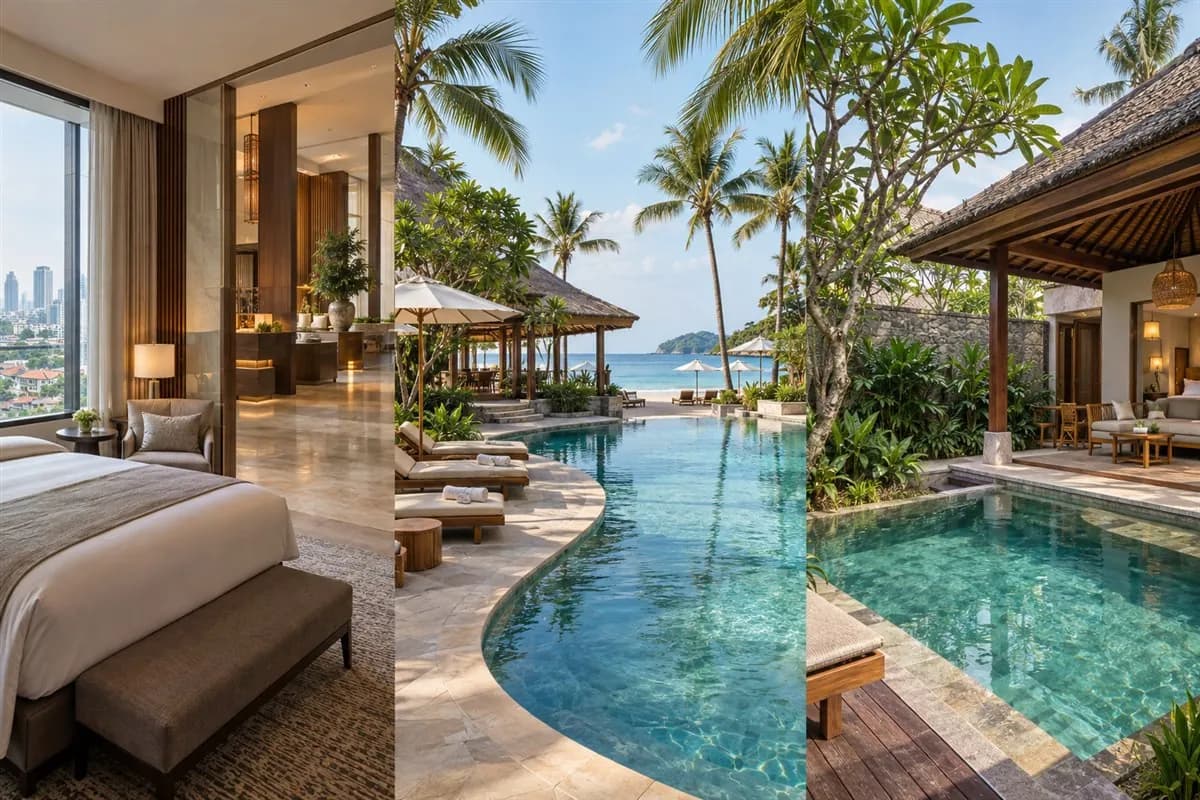
- Three stay types explained
- Privacy and service compared
- Total-cost checklist
- Recommendations by trip style
The name is only the beginning
Choosing between a hotel, resort and villa sounds simple until three listings use the same words for very different stays. A property called a resort may be a conventional hotel beside a beach. A villa may be one private house, one unit inside a managed complex or several bedrooms rented separately. A hotel may offer everything from a compact city room to a self-contained apartment with a kitchen.
Official tourism statistics also show that the categories overlap. Eurostat places resort hotels within hotels and similar accommodation, while holiday accommodation can include self-contained houses, bungalows, cottages and villas. The practical lesson is clear: use the label to begin a search, then verify the exact unit, services, facilities and booking conditions.
For most travellers, the choice comes down to six questions. How much service do you want? How much private space do you need? Will you spend most of the day at the property? Do you need a kitchen? How important is a central location? What is the final cost after taxes, breakfast, cleaning, transport and deposits? This guide answers those questions and shows which format fits different holidays.
- Read the unit description, not only the property name.
- Confirm whether the booking is for a room or an entire property.
- Compare the final total for the complete group.
- Open the map before comparing facilities.
What is a hotel?
A hotel usually rents individual rooms or suites within a property under common management. Guests normally have a private bedroom and bathroom while sharing entrances, corridors and facilities such as reception, restaurants, lifts, a gym or a pool. Daily cleaning and bed-making are characteristic hotel services in formal accommodation classifications, although the exact schedule may vary by rate and property policy.
Hotels are strongest when convenience and predictable service matter. A staffed reception can help with check-in, luggage storage, maintenance and local information. Central business and transport districts often have more hotels than private villas, making them practical for short stays, early departures and itineraries with little time at the property.
The trade-off is limited private living space. A standard room may feel restrictive for a family, several adults or a long stay. Cooking facilities are uncommon outside apartment hotels, and adjacent rooms are not automatically connecting. Shared corridors, breakfast rooms and pools also provide less seclusion than a whole villa.
What is a resort?
A resort is commonly a hotel-style property designed to make the stay itself a major part of the holiday. It may combine rooms or villas with pools, restaurants, recreation, children's facilities, a spa, a beach or organised activities. The word does not guarantee a minimum range of facilities across every country or platform, so inspect the current list rather than assuming that every resort is self-contained.
Resorts work well when travellers want slower days and fewer daily transfers. Families may value supervised activities, several dining options and pools within one managed area. Couples may prefer a spa, beach access or a quiet adult-oriented wing. A remote resort can provide an easy retreat when its facilities genuinely match the group.
Convenience inside the property can create dependence on it. Restaurant prices, compulsory meals, resort fees, activity charges and airport transfers may raise the total. A beachfront label does not confirm swimmable conditions, and a large site can involve long walks or internal shuttle services. Travellers planning daily sightseeing may pay for facilities they rarely use while spending extra time reaching town.
What is a villa?
A villa is generally a self-contained house or house-like holiday unit offering more private living space than a standard room. It may include several bedrooms, a lounge, kitchen or kitchenette, garden and private pool. Some villas are fully independent rentals; others sit within a resort and receive reception, breakfast, housekeeping and maintenance from the wider property.
Villas can offer excellent value for families and groups when the total is divided across occupied bedrooms. Shared living and dining areas make it easier to spend time together, and a kitchen supports dietary needs, young children or longer stays. A private pool and enclosed outdoor area can also create a relaxed base without sharing facilities with many guests.
Service varies more widely than the word villa suggests. Confirm whether staff are on site, housekeeping frequency, breakfast, pool maintenance, security, check-in arrangements and support after hours. Ask whether the listing is the entire villa or a room inside one. Verify approved occupancy and real beds; a property advertised for eight guests may rely on sofa beds or extra mattresses.
Hotel vs resort vs villa at a glance
Choose a hotel when location, a staffed desk and a straightforward room are the priorities. Choose a resort when the group expects to use on-site pools, dining, recreation and other facilities for a meaningful part of the holiday. Choose a villa when private shared space, multiple bedrooms or a kitchen matters more than immediate access to full hotel services.
Privacy usually increases from a standard hotel room to a private villa, but the pattern is not absolute. A secluded resort suite can feel more private than a villa beside a busy road. Service often increases from an independent villa to a full-service hotel or resort, yet a staffed luxury villa may include a host, chef and daily housekeeping. The exact listing always overrides the general category.
Space should be measured, not inferred. Check room or building area, bedroom count, bathroom count and floor plan. A two-bedroom villa gives a family separation that two hotel rooms may not, but connecting hotel rooms can provide more bathrooms and stronger sound separation. Compare the actual layouts for the same group.
- Hotel: strongest for location and predictable service
- Resort: strongest for on-site leisure
- Villa: strongest for private shared space
- Apartment hotel: useful middle ground for service plus a kitchen
Which option is best for couples?
A hotel suits couples building a busy city itinerary because reception, transport access and a compact room reduce friction. A central location may be more valuable than a private pool when most days begin early and end after dinner. Check room orientation and recent noise reviews if sleep is important.
A resort works for a beach break, honeymoon or restorative stay when both travellers want restaurants, a pool and activities close by. Review whether the atmosphere matches the trip: a large family resort, conference property and quiet couples retreat can share the same facilities list but feel completely different.
A one-bedroom villa offers seclusion and space for couples who value privacy. Consider the practical side of isolation, including road access, lighting, food delivery, reception contact and the distance to restaurants. A private setting is only relaxing when transport and support are clear.
Which option is best for families and groups?
Families should begin with sleeping arrangements and supervision rather than the most attractive pool photograph. Hotels provide reception support and may offer connecting rooms, lifts, breakfast and children's facilities. Confirm connecting rooms in writing because adjacent rooms are not the same. Ask about cot availability, child breakfast charges and pool barriers.
Resorts can simplify a family holiday with activities and several meal options, particularly when children and adults want different schedules. Check age rules, operating hours, reservation requirements and whether children's programmes are supervised. Large grounds, steps and beach conditions can affect families with strollers or limited mobility.
Villas keep a group together and can be economical per person, but they require clearer coordination. Confirm bedroom access, stairs, bathroom placement, kitchen equipment, parking and quiet-hour rules. Establish who holds the key and who contacts the host if a flight arrives late. For a private pool, ask about fencing, alarms or other safety measures rather than assuming they exist.
Compare the total price, not the nightly headline
A hotel rate may exclude breakfast, parking, taxes or an extra bed. A resort may add a compulsory dinner, facility charge, transfer or activity fee. A villa may have cleaning, electricity, security-deposit or late-arrival conditions. Open the final checkout summary and property policies before deciding which displayed price is lower.
Calculate the total for the entire group and stay, then divide only when every bedroom and bed will actually be used. Add realistic transport. A remote villa with a low nightly rate can cost more after private drivers and food delivery; a central hotel can reduce those expenses. Conversely, a villa kitchen may lower meal costs for a family on a longer stay.
Cancellation value matters as much as price. Compare the deadline, time zone, payment timing, deposit, refund method and no-show rules. A small saving on a non-refundable property is not automatically good value when flights or leave remain uncertain.
Location and access can change the whole holiday
Open the map and test travel to every fixed stop at approximately the time you expect to move. A centrally located hotel can be efficient for stations, museums and restaurants. A resort may be intentionally distant from town. A villa pin can sit in a narrow lane, hillside or residential neighbourhood where taxis, parking and pedestrian access require planning.
Do not rely on straight-line distance. Traffic, one-way streets, ferry schedules, elevation and road quality change travel time. In Indonesia, an accommodation name may refer to a broad destination rather than a compact district. Confirm the exact entrance and ask the property about the appropriate transfer method.
Accessibility also needs property-specific confirmation. Ask about step-free routes from arrival to the room, lift dimensions, bathroom layout, pool access and distance across the grounds. A ground-floor villa can still have steps at the entrance, while a hotel lift does not guarantee an accessible bathroom.
A booking checklist that works for all three
Confirm the legal property name, exact unit, guest count, beds, bathrooms, check-in process and support contact. Review recent feedback for cleanliness, maintenance, water, air conditioning, noise and how staff respond when something goes wrong. Photographs show design; recent operational reviews reveal whether the stay functions well.
Read the complete facility details. Private, shared and available can mean different things. A private pool may belong to the booked villa, while a private beach may mean managed access to a shoreline still affected by tides and public rules. A kitchen may contain only a microwave and sink. Ask a focused question when a feature determines the booking.
Keep the confirmed voucher, address and contact details available offline. Pay through the recorded booking channel, verify the beneficiary and save receipts. Never move payment to an unfamiliar personal account because someone in a message promises a hidden discount. On arrival, report material differences promptly through the platform and property while evidence is current.
- Exact room or whole-property name
- Approved occupancy and real beds
- Private versus shared facilities
- Final price and deposit
- Cancellation deadline and time zone
- Map, entrance and transfer plan
- Accessibility confirmed directly
- Voucher and support contacts saved offline
The right answer depends on how you will use the stay
A hotel is usually the safest default for a short, active trip. A resort earns its premium when on-site leisure is a central part of the holiday. A villa becomes compelling when a family or group will use its bedrooms, living area, kitchen and privacy. None is universally better; each directs the travel budget toward a different experience.
Create a shortlist with one strong option from each relevant category. Compare the same dates and guests, then remove facilities the group will not use. Read the map and policies before being persuaded by photographs. This makes the choice concrete: service and location, recreation and convenience, or private space and independence.
The best accommodation is the one that supports the itinerary without adding avoidable work. When the name and reality differ, choose the reality: the exact unit, complete price, accessible location and services confirmed for your stay.
Frequently asked questions
What is the main difference between a hotel, resort and villa?
A hotel usually rents serviced rooms under common management. A resort is generally a hotel-style property where recreation and on-site facilities are central to the stay. A villa is usually a self-contained house-like unit offering more private living space.
Is a resort always more expensive than a hotel?
No. Prices depend on destination, dates, room type and inclusions. Compare the final total, including meals, resort fees, transfers and activities, with an equivalent hotel booking.
Is a villa cheaper for a family?
It can be when several occupied bedrooms and a kitchen replace multiple hotel rooms and restaurant meals. Add cleaning, deposits, transport and any utility charges before comparing per-person value.
Does every villa include a private pool?
No. Some villas have no pool or use a shared pool within a complex. Confirm that the pool belongs exclusively to the exact unit being booked.
Do resorts include all meals and activities?
Only when the selected rate explicitly says so. Resort, full board and all-inclusive are different concepts. Check every inclusion, operating time and reservation requirement.
Which accommodation is best for a short city break?
A centrally located hotel is often the most practical because it combines transport access, reception and a straightforward room. An apartment hotel can help when a kitchen or extra space is needed.
Which stay offers the most privacy?
A whole private villa often provides the most exclusive space, but location, staff access and neighbouring properties matter. Verify which areas are private and when housekeeping or maintenance may enter.
What should I compare before booking?
Compare the exact unit, total guest count, beds, bathrooms, facilities, location, total price, deposit, housekeeping, check-in support and cancellation terms for the same dates.
Sources and further reading
We used the following primary consumer resources to review time-sensitive claims in this guide.
Search hotels, resorts and villas for the same dates
Use the complete guest count, inspect the map and compare an equivalent room or whole property with the same cancellation terms.
Affiliate disclosure. This page contains Traveloka affiliate links. We may earn a commission when you book through them, at no additional cost to you. Commercial relationships do not determine our editorial recommendations.