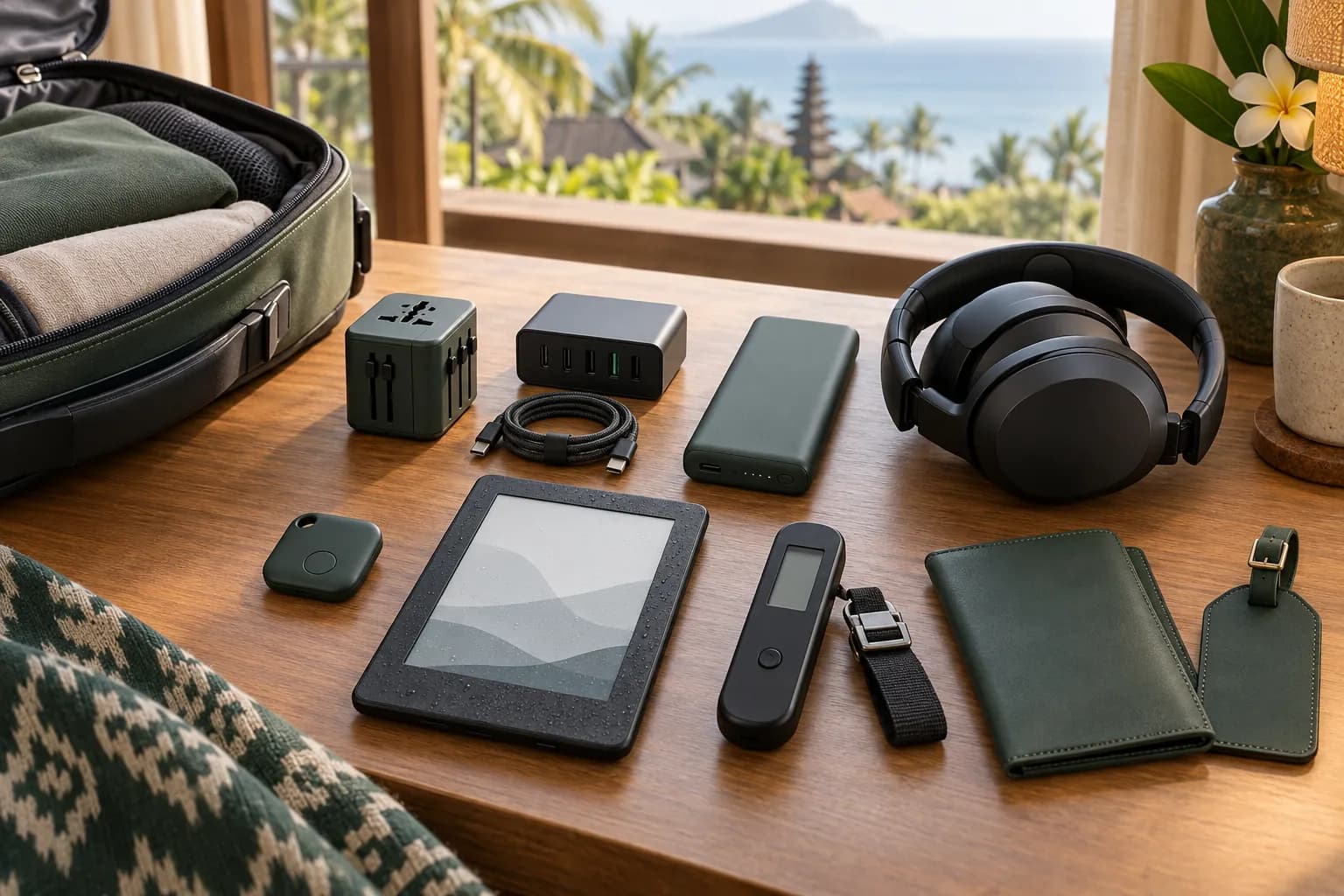
- Seven genuinely useful gadgets
- 2026 battery-flight guidance
- Buying specifications explained
- Packing and safety checklist
The travel gadgets worth carrying in 2026
The best travel gadget earns its place in the bag more than once. It solves a predictable problem, works with the devices already owned and does not create a new tangle of chargers, batteries or apps. A compact adapter can make an international hotel room usable; a compliant power bank can rescue a phone during a disrupted journey; a luggage scale can prevent a costly surprise before check-in.
This guide selects seven categories rather than declaring one permanent product winner. Models, prices and stock change, and a gadget that is ideal for one phone or country can be wrong for another. Each recommendation therefore explains the specification to check before using the Amazon product link. Compare the live listing, seller, warranty, plug type, battery rating and device compatibility before purchase.
The article contains affiliate product links. If a qualifying purchase is made through an eligible Amazon link, this site may receive a commission without increasing the buyer's price. Editorial selection remains based on practical travel use and safety considerations.
- Buy for your actual devices and destinations.
- Prefer recognised safety certification and a clear warranty.
- Check dimensions and weight instead of trusting 'travel size'.
- Read the airline's current battery rules before flying.
1. A grounded universal travel adapter
A universal travel adapter changes the physical plug connection so a charger can fit sockets in different countries. It does not automatically convert voltage. That distinction is essential. Many modern phone and laptop chargers accept an input such as 100–240 V and 50/60 Hz, but hair dryers, styling tools and small appliances may not. Read the input label on every device before connecting it abroad.
Look for an adapter that clearly lists the supported plug regions, maximum current and voltage, grounded support where appropriate, replaceable or resettable protection, shutters over live contacts and credible independent safety certification for the market where it is sold. Built-in USB-C ports can reduce the number of separate chargers, but their total wattage is shared across ports. A 65 W label may mean 65 W from one port and less when several devices are attached.
Avoid stacking a loose adapter with a heavy charger where it can fall from the wall. Do not connect high-power appliances unless both the adapter and appliance are rated for the local supply. A compact adapter is ideal for phones, tablets, cameras and laptops with compatible chargers; it is not a universal solution for every electrical device.
2. A compact multi-port GaN USB-C charger
Gallium nitride, commonly shortened to GaN, allows many chargers to deliver useful power from a smaller body than older designs. A multi-port USB-C charger can replace separate phone, tablet, watch and laptop bricks, which saves space and reduces the chance of leaving a charger behind. The important number is not the largest wattage printed on the box; it is the output available to each port in the combinations you will use.
Check the laptop's required USB Power Delivery profile and cable rating. Some ultraportable laptops are comfortable at 45 or 65 W, while larger machines may demand substantially more. A 100 W charger will not deliver 100 W through a cable rated for less, and its output may drop when a second device is connected. Read the port-allocation table rather than relying on the product title.
Choose folding pins when suitable for the marketplace, a body that remains secure in the wall, and temperature and over-current protection backed by credible certification. Pack one spare cable separately. A charger is only genuinely compact when its cables, destination adapter and required connectors remain simple as a complete system.
3. An airline-compliant USB-C power bank
A power bank keeps a phone available for boarding passes, maps, translation and communication when outlets are unavailable. For air travel, the label matters as much as capacity. The FAA states that spare lithium batteries, including power banks, must travel in carry-on baggage and not checked baggage. Units up to 100 watt-hours generally fall within the standard passenger allowance, while larger batteries can require airline approval or be prohibited.
IATA's 2026 passenger guidance says passengers are limited to a maximum of two lithium-ion power banks not exceeding 100 Wh, that power banks must not be recharged from the aircraft supply, should not be stored in overhead lockers and should not power other devices during taxi, take-off or landing. Airlines may impose stricter rules, so check the operating carrier before every flight. Keep the bank accessible and protected from crushing or short circuits.
For everyday travel, 10,000–20,000 mAh is a useful range, but confirm the printed Wh rating. Choose USB-C input and output, Power Delivery suitable for the intended device, a clear capacity label and credible protection circuitry. Never travel with a swollen, damaged or recalled battery. Stop using a unit that becomes unusually hot, expands, leaks or smells abnormal.
4. A Bluetooth luggage tracker
A luggage tracker can help establish whether a bag remained at an airport or moved toward the next location. It does not replace the airline's baggage tag, lost-bag report or compensation process. Bluetooth-network trackers depend on nearby compatible devices and may show a delayed position; they are not continuous satellite GPS units.
Choose a tracker compatible with the phone ecosystem used by the traveller, with a replaceable or adequately long-life battery and alerts designed to discourage unwanted tracking. Test it before departure, give it a recognisable name without publishing sensitive personal data, and place it inside the bag where it will not detach. Do not confront another person based only on a map pin; share the information with the airline or relevant authority.
The FAA currently permits qualifying small Bluetooth location trackers in carry-on and checked baggage when their lithium content or watt-hour rating stays within the stated small-battery limits. Airline rules can be more restrictive. Some tracker ecosystems allow a lost item's location to be shared temporarily with participating airlines, but support varies by carrier and airport.
5. Comfortable noise-cancelling headphones or earbuds
Noise cancellation can reduce the steady low-frequency sound of aircraft cabins, trains and air-conditioning, making spoken audio easier to hear at a safer listening level. Over-ear headphones often provide longer battery life and passive isolation, while true-wireless earbuds occupy far less space. Comfort after two hours matters more than a short shop demonstration.
Compare weight, clamp pressure, ear-tip sizes, battery life with noise cancellation active, wired listening support and the quality of transparency mode. A detachable 3.5 mm cable is useful for entertainment systems that do not support Bluetooth. Some aircraft use a two-prong socket, so a small airline audio adapter may still be needed.
Do not block essential announcements during boarding, street crossings or unfamiliar public spaces. Keep volume moderate and take listening breaks. Lithium-powered headphones are safest in carry-on baggage, and the airline may ask that wireless functions be disabled during particular phases of flight.
6. A waterproof e-reader
An e-reader can carry books, guide material and offline documents at a fraction of the space required by paper. E-ink displays remain readable in bright light and generally consume power only when the page changes, allowing much longer battery life than a tablet. A waterproof model can be reassuring beside a pool, on a boat or during a rainy transfer, within the manufacturer's stated rating.
Choose screen size, warm-light control, storage and library ecosystem before comparing small price differences. Confirm that books can be purchased or borrowed in the traveller's country and that the chosen format supports any documents you intend to load. Download essential titles before departure rather than relying on hotel Wi-Fi.
An e-reader is most valuable for travellers who genuinely read. A phone may be sufficient for a short trip, while students or creative professionals might prefer a tablet that can display colour PDFs and accept a keyboard. Pack the lightest protective cover that shields the screen from bending pressure inside the bag.
7. A compact digital luggage scale
A luggage scale is a simple tool with a clear financial purpose: it helps identify an overweight bag before reaching the airport desk. This is particularly useful on itineraries combining international and domestic flights because the smallest baggage allowance can govern one part of the journey. It also helps distribute weight between bags before leaving a hotel.
Look for a secure strap, a display readable while the bag is suspended, a hold function, selectable kilograms and pounds, and a capacity above the heaviest bag you are allowed to check. The device should be comfortable to grip with two hands. Compare its reading with a known scale occasionally and treat small differences as a reason to stay below the airline limit rather than packing to the last decimal.
Lift with a stable stance and avoid weighing a bag that exceeds your safe handling ability. A scale does not measure dimensions, so check cabin-bag size separately. If the scale uses a coin-cell or other spare battery, protect replacement batteries from short circuit and follow current airline rules.
How to avoid buying seven gadgets that create more clutter
Audit what is already owned. A modern phone may replace a camera, translator, boarding-pass wallet and entertainment player. One GaN charger can replace several bricks, while the right power bank can charge both phone and small laptop. Choose USB-C where practical so fewer cable types cover more devices.
List every item with its weight, cable and charging requirement. If a gadget serves only one unlikely scenario, leave it at home. Test the complete kit for a normal day before travelling: charge everything from one outlet, locate the tracker, read the luggage scale and use the headphones for a full film. Discovering incompatible cables at home is cheaper than solving them at an airport.
Buy from a reputable seller and inspect model numbers, warranty and certification. Marketplace listings can combine reviews for multiple variants, so filter to the exact size or model. Extremely cheap batteries, adapters and chargers deserve particular caution because a failure can damage other equipment or create a fire risk.
A carry-on technology packing checklist
Place power banks and spare lithium batteries in the cabin bag, protected from damage and accidental short circuit. If the carry-on is gate-checked, remove those items first. Keep watt-hour labels visible and bring no damaged or recalled battery. Check the airline's latest restrictions because carriers can impose stricter limits than general guidance.
Download offline maps, accommodation vouchers, insurance details, books and essential documents. Update device software before departure, enable a strong screen lock and back up important data. Avoid unknown charging cables and do not leave unlocked devices unattended in public charging areas.
Pack the adapter and main charger where they can be reached on arrival, but keep the luggage scale accessible before airport check-in. Use a small cable pouch and label similar black chargers discreetly. The objective is a compact system that is easy to inventory, not a bag filled with accessories.
- Power banks in carry-on only
- Visible Wh rating and protected terminals
- One tested charger-and-cable system
- Offline maps and vouchers
- Strong device lock and current backup
- Airline rules checked before departure
Which gadgets should you buy first?
For international travel, start with a safe adapter and a charger that matches every essential device. Add a compliant power bank when days involve long transfers or navigation. Frequent flyers gain more from comfortable noise cancellation and a luggage scale. A tracker becomes valuable for checked baggage, while an e-reader is worthwhile for someone who already reads regularly.
Prioritise quality where electrical or battery safety is involved. An expensive gadget is not automatically safer, but clear specifications, credible certification, traceable support and a real warranty are worth more than decorative features. Buy early enough to test and return a product before departure.
Seven gadgets are not mandatory for every traveller. The best kit may contain three. Choose the smallest group that keeps power, information, baggage and comfort under control, then leave space for the journey itself.
Frequently asked questions
What are the most useful travel gadgets?
A safe travel adapter, multi-port USB-C charger, compliant power bank, luggage tracker, noise-cancelling headphones, e-reader and digital luggage scale solve common travel problems without requiring specialised skills.
Can I put a power bank in checked luggage?
No. Spare lithium batteries and power banks must be carried in cabin baggage under FAA and IATA guidance. Check the operating airline because stricter limits may apply.
What power bank size is allowed on a plane?
Power banks up to 100 Wh are generally within the standard allowance. IATA's 2026 guidance limits passengers to two units not exceeding 100 Wh, while airlines can impose stricter conditions.
Does a universal travel adapter convert voltage?
Usually not. It changes the plug connection. Read each device's input label and use a suitable voltage converter only when the appliance and destination supply require one.
Is a GaN charger better for travel?
It can provide useful USB-C power from a compact body, but check port sharing, Power Delivery profiles, cable ratings and safety certification rather than buying from the GaN label alone.
Are Bluetooth luggage trackers allowed on planes?
Qualifying small trackers can be allowed under current battery rules, but battery specifications and airline policies matter. A tracker supplements rather than replaces the airline's baggage process.
Should I buy earbuds or over-ear headphones for flying?
Earbuds save space, while over-ear models often provide longer battery life and passive isolation. Choose according to long-session comfort, noise cancellation, transparency mode and wired support.
How accurate is a digital luggage scale?
A good scale is useful for estimating baggage weight, but readings can vary slightly. Test it periodically and leave a margin below the airline limit.
Are the product links in this article affiliate links?
Product buttons are prepared for Amazon Associates attribution. When a valid Associate tag is active, qualifying purchases may generate a commission without increasing the buyer's price.
Sources and further reading
We used the following primary consumer resources to review time-sensitive claims in this guide.
Browse travel gadgets in one place
Check specifications, seller, warranty and current airline compatibility before ordering any product.
Affiliate disclosure. This page contains Amazon product links prepared for Associates attribution. When a valid Associate tag is active, we may earn a commission from qualifying purchases at no additional cost to you. Commercial relationships do not determine our editorial recommendations.