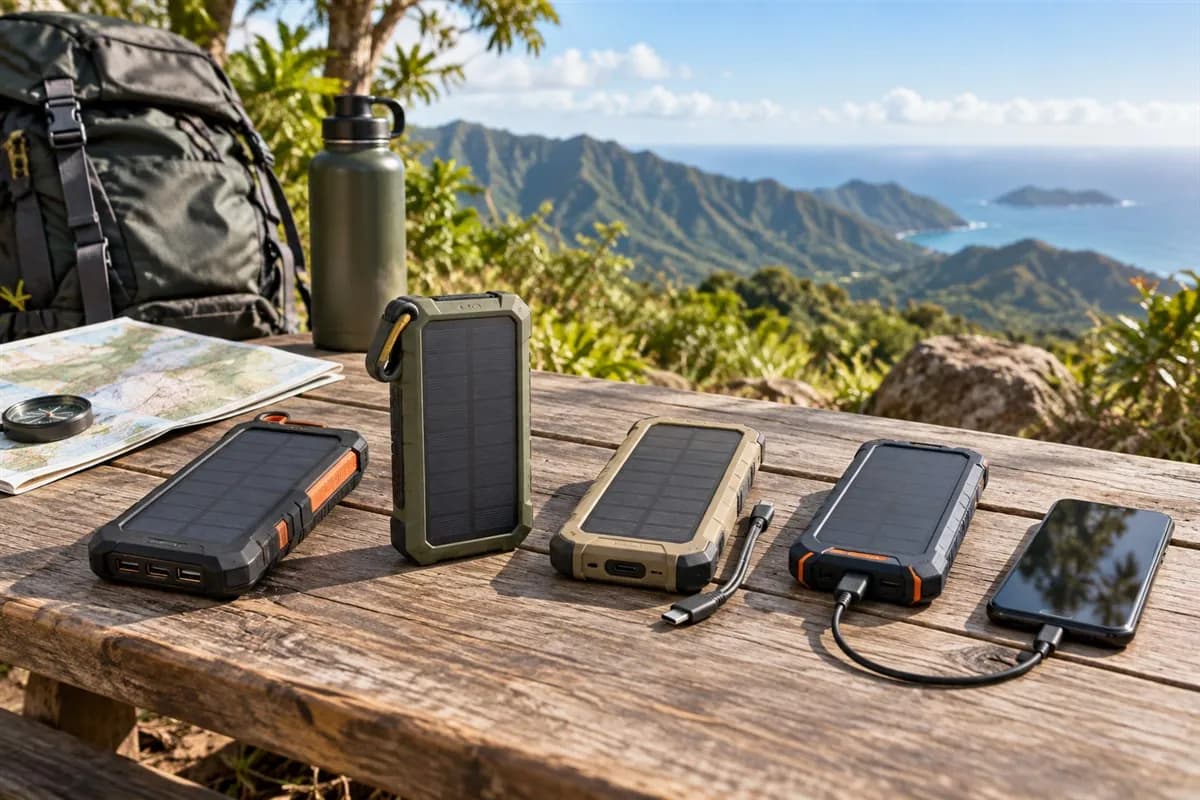
- Four outdoor power options
- Realistic solar expectations
- Flight battery rules
- Capacity and safety checklist
A solar power bank is backup power, not unlimited power
A solar power bank can keep a phone available for maps, weather information, emergency messages and transport details when a wall outlet is far away. That makes it attractive for hiking, camping, island trips and disruption planning. The useful part is still the rechargeable battery: it stores energy at home, in a hotel or from a larger panel, then releases that energy when a device needs it.
The small photovoltaic panel built into many power banks should be treated as an emergency top-up rather than the primary charging method. The U.S. Department of Energy explains that photovoltaic output depends on the light reaching the cells and on conversion efficiency; location, time, weather, angle and temperature all affect performance. A panel only slightly larger than a phone has limited collection area, while advertised battery capacities can require substantial energy to refill. Cloud, shade, a poor angle and heat make the process slower.
Charge the bank fully by USB before departure, download critical maps and reduce unnecessary device consumption. If daily off-grid charging is essential, a separate foldable solar panel with a clearly stated wattage generally offers far more collection area than a single integrated panel. Test the complete setup at home in realistic sunlight rather than discovering its limitations during an emergency.
This guide recommends four useful solar power bank types instead of naming unverified winners. Models, battery cells and seller listings change, and safety recalls can affect a specific production run. Each Amazon button initially opens a tagged comparison search using the Associate ID jalajahtravel-20. Four direct product links can replace those searches later in the same order.
- Fully charge by USB before every trip.
- Treat the built-in panel as emergency input.
- Keep the printed Wh label readable.
- Test cables, ports and solar input at home.
1. A compact 10,000 mAh solar power bank for day trips
A compact solar power bank around the 10,000 mAh class can balance useful phone backup with a manageable pack weight. It suits day hikes, city-to-trail excursions and travellers who need one or two partial recharges rather than several days of independent power. Capacity printed in milliamp-hours is measured at the battery's internal voltage; conversion losses mean the energy delivered to a phone will be lower than a simple division of the two mAh figures suggests.
Look for a clear watt-hour rating, USB-C input and output, a stable charge indicator and protection against over-current, over-voltage, short circuit and excessive temperature. Confirm whether the USB-C port actually provides Power Delivery or is only a basic connector. Check the exact weight because rugged casing, lights and carabiners can make a compact-looking unit unexpectedly heavy.
The integrated panel is useful for maintaining awareness of available sunlight and adding a small amount of energy over time. Do not attach the unit loosely outside a pack where branches, impacts or rain can damage it. A carabiner hole is an attachment point, not proof that the product is safe to swing from a bag all day. Keep it secure and inspect the case after every hard knock.
2. A higher-capacity USB-C model for multi-day camping
A higher-capacity model can support a phone, headlamp, watch and small camera across a longer trip. The benefit comes with more weight and a longer recharge time. Capacity should be chosen from an energy budget: list each essential device, estimate how much energy it uses per day, add conversion losses and preserve a reserve for communication. Avoid carrying a large battery simply because a marketplace title displays a dramatic number.
For laptops or fast-charging phones, compare USB Power Delivery profiles and the maximum output from each port. Total output may fall when several devices charge at once. Confirm that the included cable supports the required wattage. A digital percentage display is convenient, but it is still an estimate; test how the bank behaves near empty and how much of a normal device charge it actually supplies.
Air travel changes the selection. FAA guidance limits ordinary lithium-ion power banks to 100 Wh per battery, requires them in carry-on baggage and allows airlines to apply stricter quantity or Wh limits. Larger 101–160 Wh batteries can require carrier approval, and units above 160 Wh are generally forbidden on passenger aircraft. Check the operating airline before every trip and avoid a product whose Wh rating is missing or unclear.
3. A rugged weather-resistant power bank for wet routes
A rugged solar power bank may add reinforced corners, sealed port covers and a published ingress-protection rating. This can help on humid trails, beach transfers and campsites where dust or splashes are possible. Weather-resistant does not mean safe to submerge, charge while wet or leave in driving rain. The exact IP rating has two digits and applies only under stated test conditions, usually with every cover properly closed.
Inspect the seal around each port, the joint between the panel and case, and whether the cover remains attached after repeated use. Dry the exterior and connectors before charging another device. Salt water is particularly corrosive; keep electronics away from surf and wipe the case according to the manufacturer's instructions after coastal exposure. Never place a damp battery inside a sealed pouch with no opportunity to dry.
Rugged construction cannot protect a lithium battery from every impact or temperature. Stop using a unit that swells, cracks, leaks, smells unusual or becomes abnormally hot. The U.S. Consumer Product Safety Commission publishes recalls for power banks that can overheat and ignite, so check the exact brand, model and serial number before a long trip and follow any recall instructions immediately.
4. A fold-out solar power bank for better collection area
A power bank with several fold-out solar leaves provides more photovoltaic area than a single panel on the case. In suitable direct sunlight, that can improve solar input while keeping the battery and charging controller in one package. The trade-offs are bulk, hinges, additional surfaces that can be damaged and a shape that may be awkward to position safely.
Compare the panel's stated maximum wattage with the battery's energy in watt-hours. These numbers help reveal whether a full solar recharge is remotely practical, but real output will still be lower and variable. Look for regulated input, charge-status information and instructions for positioning the panels. Place the unit where air can circulate and move the battery itself out of intense heat when the design permits; solar cells need light, while lithium batteries should not be baked on a hot rock or behind vehicle glass.
This type best suits base camps and slower travel where the panels can remain stationary and supervised. It is a poor choice for walking with the panels flapping from a backpack. If dependable daily solar power is critical, compare the integrated design with a separate foldable panel connected to a protected power bank in the shade. Separate components often allow better panel orientation and thermal management.
How long does solar charging really take?
A useful estimate begins with energy, not the largest mAh number in the title. Find the power bank's watt-hour capacity and the solar panel's realistic output in watts. Dividing Wh by W gives an idealised number of full-sun hours before conversion losses, changing sunlight, charge-controller behaviour and temperature are considered. Real elapsed time can be much longer because good sunlight is not constant throughout the day.
For example, a large battery paired with a very small integrated panel may need many days of favourable exposure for a full recharge. This is why a panel indicator lighting up does not prove that meaningful energy is entering the battery. Record the starting percentage, expose the panel safely for a measured period and compare the change. Repeat in realistic conditions before relying on it outdoors.
Solar charging works best when the panel faces strong direct light without partial shade. Even a strap or leaf across part of the panel can reduce useful output. Clean dust gently according to the product instructions. Do not place the power bank where it could fall, overheat, get soaked or be stolen, and do not leave a lithium battery unattended in extreme heat merely to chase sunlight.
Battery safety on trails, at campsites and on flights
Buy from a traceable seller and confirm the manufacturer, exact model, safety certification, warranty and recall information. Marketplace reviews may combine several capacities or generations, so filter for the precise variant. Charge the unit on a non-flammable surface before the trip and watch the first complete cycle. Do not cover it, place it inside bedding or use a damaged cable.
Protect the ports from metal objects and the case from crushing. FAA guidance says power banks and other spare lithium batteries must remain in carry-on baggage with terminals protected against short circuit. If a carry-on is gate-checked, remove the power bank and keep it in the cabin. Alert crew immediately if a battery overheats, expands, smokes or burns during a flight.
At camp, keep power banks away from a stove, campfire, direct midday heat and standing water. Do not charge inside a tightly closed hot tent. Store the battery where it cannot be stepped on and where animals cannot reach cables. A built-in flashlight can be useful, but it is not a substitute for a dedicated headlamp with independent power.
- No swollen, cracked, recalled or unusually hot battery
- Readable Wh and model labels
- Carry-on baggage only for flights
- Protected ports and terminals
- Kept away from fire, water and extreme heat
- Tested with every cable before departure
Build an outdoor power plan before choosing capacity
Start with the phone because it often carries navigation, emergency contacts and permits. Download offline maps, lower screen brightness, disable unnecessary radios and use airplane mode where appropriate. Carry a paper map and compass when the route requires them, and learn how to use those tools. A battery should add resilience rather than create dependence on one electronic system.
Next, separate essential and optional loads. A satellite communicator or medical device has a different priority from a speaker or action camera. Check whether every essential device can share USB-C cables and whether the power bank can charge them at their required voltage. Bring one tested backup cable in a separate pouch because cable failure is more common and easier to solve than battery failure.
Choose the compact model for a day trip, the higher-capacity USB-C type for several essential devices, the rugged model for wet or dusty routes, and the fold-out design when supervised solar collection at a base camp is realistic. Then verify the exact product listing, printed label and airline policy. The best solar power bank is the one that fits a tested power budget and remains safe in the actual environment.
Frequently asked questions
Are solar power banks useful for outdoor travel?
Yes, primarily as charged battery storage with emergency solar input. Fully charge by USB before departure. A small integrated panel usually collects energy slowly compared with a larger foldable panel.
Can a solar power bank charge fully from sunlight?
It may be technically possible for some models, but elapsed time can be very long. Battery Wh, panel wattage, angle, weather, shade, temperature and conversion losses all affect the result.
What capacity solar power bank should I choose?
Build an energy budget for essential devices, then compare usable energy, weight and printed Wh. A compact unit suits day trips, while longer trips may justify more capacity or a separate larger solar panel.
Can I take a solar power bank on a plane?
The battery makes it subject to power-bank rules. FAA guidance requires power banks in carry-on baggage and generally limits ordinary lithium-ion units to 100 Wh, while airlines can impose stricter rules.
Is a waterproof solar power bank safe in rain?
Only within the exact published ingress-protection conditions, usually with covers closed. Do not charge through wet connectors, submerge the unit or assume the word waterproof applies in every situation.
Does more mAh always mean a better power bank?
No. Higher capacity adds weight and charging time. Cell quality, usable output, Wh labelling, USB protocols, protection circuits, temperature management and warranty also matter.
Can I leave a solar power bank in direct sun all day?
Follow the manufacturer's temperature and charging instructions. The panel needs light, but excessive heat can reduce solar performance and harm lithium batteries. Avoid hot vehicles, rocks and enclosed spaces.
Are these Amazon links affiliate links?
Yes. Eligible Amazon links use the Associate ID jalajahtravel-20. Qualifying purchases may earn this site a commission without increasing the buyer's price.
Sources and further reading
We used the following primary consumer resources to review time-sensitive claims in this guide.
Browse solar power banks for outdoor travel
Check the printed Wh rating, USB-C output, solar input, weather-resistance conditions, seller and recall status before ordering.
Affiliate disclosure. As an Amazon Associate, we may earn from qualifying purchases made through eligible links on this page, at no additional cost to you. Product availability, specifications and safety notices can change; our editorial guidance remains independent of commercial relationships.