- Five living traditions
- UNESCO context
- Where to look for performances
- Respectful audience etiquette
Living heritage, not a sightseeing checklist
Indonesia's performing arts carry stories, belief, humour, social memory, and community identity. Some appear regularly on ticketed stages; others belong to ceremonies or seasonal events. Seeing a tourism performance and witnessing a community ritual are therefore not interchangeable experiences.
This guide introduces five traditions and helps you plan without presenting one version as the only authentic form. Spellings, repertoires, instruments, costumes, and performance settings vary among communities. Check the current programme with the venue or local cultural office before travelling for a show.
- Choose community-led or established cultural venues.
- Confirm the date, language support, duration, and ticket inclusions.
- Ask before photographing performers, ceremonies, or backstage areas.
1. Wayang kulit in Java
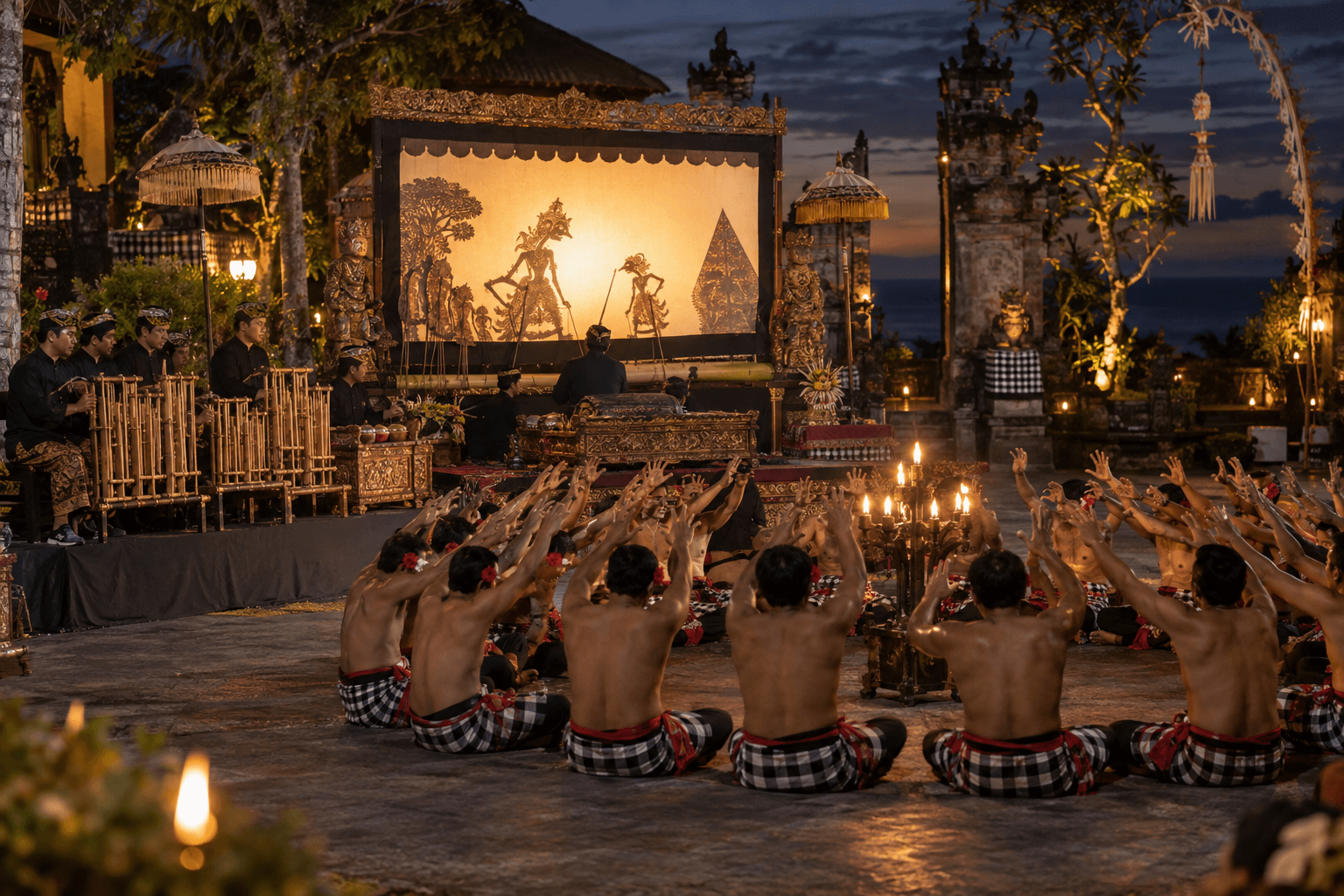
Wayang is a family of Indonesian puppet-theatre traditions, not just one fixed show. In wayang kulit, a dalang manipulates flat leather puppets against a lit screen while musicians and singers shape the drama. Stories may draw from local narratives, the Ramayana and Mahabharata, or other literary traditions, and comic characters can carry moral commentary and social criticism.
UNESCO inscribed Wayang puppet theatre on the Representative List of the Intangible Cultural Heritage of Humanity in 2008, following its 2003 proclamation. The listing covers a broader tradition that includes different puppet forms and regional styles, so it should not be reduced to a single Yogyakarta performance format.
Traditional performances can run late or through the night, while museums, palaces, arts centres, and tourism venues may present shorter programmes. Ask whether visitors watch from the shadow side, the puppeteer side, or both, and whether an English synopsis is available. Arrive quietly and avoid blocking the screen or musicians.
2. Kecak in Bali
Kecak is a Balinese dance-drama built around a coordinated vocal chorus, commonly presenting episodes from the Ramayana. Many tourism performances use little or no instrumental accompaniment, but it is safer to understand that as a feature of the production than as a rule for every Kecak context or creative variation.
Uluwatu is the best-known setting, where an open-air performance is commonly timed around sunset. Kecak is also staged in Ubud and at other Bali venues. A sunset is weather-dependent, and a popular time slot can sell out; verify the official schedule, separate temple and performance tickets, assigned entry procedure, and return transport before setting out.
Uluwatu remains an active sacred site. Wear the required temple clothing, keep distance from ceremonies, secure loose belongings around monkeys, and follow staff instructions. The UNESCO inscription for Bali concerns nine dances across sacred, semi-sacred, and entertainment genres; it should not be described as a UNESCO listing specifically for Kecak.
3. Saman of the Gayo people in Aceh
Saman is a performing tradition of the Gayo people in Aceh. Performers sit closely in rows and combine song with precisely coordinated clapping, chest and thigh movements, and changes of tempo. The poetry can carry religious, social, and cultural messages in the Gayo language.
UNESCO placed Saman dance on the List of Intangible Cultural Heritage in Need of Urgent Safeguarding in 2011. That status is different from the Representative List: it highlights a need for safeguarding and transmission, not a ranking of spectacle or popularity.
Do not assume a Saman performance is available every day or anywhere in Aceh. Look for announced cultural festivals, community programmes, and recognised arts events, then confirm the location and audience rules. Avoid interrupting rehearsals or asking a community to stage a sacred or educational practice solely for a photograph.
4. Angklung in West Java
Angklung instruments are made from tuned bamboo tubes suspended in a frame and sounded by shaking or tapping. An instrument produces a note or chord, so an ensemble depends on attentive cooperation. Traditional and modern angklung practices use different tuning systems and contexts.
UNESCO added Indonesian angklung to the Representative List in 2010, noting its connection with customs and cultural identity as well as the values of collaboration, discipline, and mutual respect. It is both an instrument and a shared musical practice, rather than simply a tourist souvenir.
Bandung is an accessible base for scheduled cultural performances and participatory workshops, including programmes associated with Saung Angklung Udjo. Schedules and formats can change, so confirm directly before travelling. During an audience workshop, wait for the conductor's cue, handle the bamboo frame carefully, and return the instrument as directed.
5. Hudoq traditions in East Kalimantan
Hudoq refers to masked dance traditions associated with several Dayak communities in East Kalimantan, including Bahau and Modang communities. Forms, names, stories, masks, costume materials, and ritual sequences vary. Some Hudoq practices are connected with the agricultural cycle and community hopes for protection and a good crop.
This is the least suitable entry on the list for a guaranteed daily show. Public festival presentations may be accessible, while community ceremonies follow local timing and authority. Treat an advertised cultural festival and a village ritual as different settings, and verify the organiser rather than turning up based on an undated social-media post.
Ask the host where visitors may stand, whether images are allowed, and which parts are private. Do not touch masks, costumes, offerings, or performers, and avoid repeating sensational descriptions such as 'monster dance' or 'mystical spectacle'; those labels flatten distinct community meanings.
How to build a responsible cultural itinerary
Start with a confirmed programme, then build transport and accommodation around it. Yogyakarta or Surakarta can anchor a wayang-focused Java trip, Bali offers multiple Kecak venues, Bandung is practical for angklung, and travel for Saman or Hudoq needs more advance research because public performances can be event-based.
Buy through the venue, organiser, or a platform that names the actual performance and inclusions. A responsible booking should tell you where the money goes, what kind of presentation you will see, and whether transport, entrance fees, or a guide are included.
- Recheck the programme shortly before travel.
- Learn the correct community and regional name for the art.
- Stay for the full performance when the format expects it.
- Support artists through authorised tickets, workshops, or crafts.
Audience etiquette that travels well
Dress for the venue, silence notifications, and keep conversation low. Never use flash unless the organiser explicitly permits it. At a temple or community ceremony, the host's instructions take priority over the desire for a clear view or video.
A short synopsis can make unfamiliar stories easier to follow, but translation never captures every reference, joke, or philosophy. Approach the performance with curiosity, avoid declaring one shortened show inauthentic, and remember that living traditions continue to change through the people who practise them.
Frequently asked questions
What are the best traditional performances to see in Indonesia?
Wayang, Kecak, Saman, angklung, and Hudoq introduce very different regional traditions. The best choice depends on your route and the current programme; some are regularly ticketed while others appear mainly at festivals or community events.
Is Kecak listed by UNESCO?
Do not describe Kecak itself as the element inscribed by UNESCO. UNESCO's 2015 entry is Three genres of traditional dance in Bali and identifies nine representative dances across sacred, semi-sacred, and entertainment genres.
Is Saman performed only by men?
UNESCO's inscription describes boys and young men in the Gayo Saman tradition. Other seated group dances and contemporary presentations may be labelled Saman in popular usage, so check the community, form, and programme rather than identifying a tradition from posture alone.
Where can travellers watch wayang kulit?
Look for current programmes at palaces, museums, arts centres, community events, and established venues in Java, especially around Yogyakarta and Surakarta. Confirm the date, duration, story synopsis, and visitor arrangements directly.
Can travellers watch Hudoq at any time of year?
No regular performance should be assumed. Hudoq traditions can be tied to agricultural and community calendars, while public festival presentations follow announced dates. Contact the organiser or local cultural authority and respect access restrictions.
May I photograph a traditional performance?
Rules differ by venue and occasion. Ask before photographing, never use flash unless expressly allowed, and stop when a host restricts images. Ceremonies, offerings, backstage areas, and individual performers may require separate permission.
Sources and further reading
We used the following primary consumer resources to review time-sensitive claims in this guide.
Compare options for your trip.
Continue to Traveloka to check current schedules, availability, and final prices for your travel dates.
Affiliate disclosure. This page contains Traveloka affiliate links. We may earn a commission when you book through them, at no additional cost to you. Commercial relationships do not determine our editorial recommendations.