- Five distinct regions
- Realistic access notes
- Volcano and ocean safety
- Best trip style for each place
How these five destinations were chosen
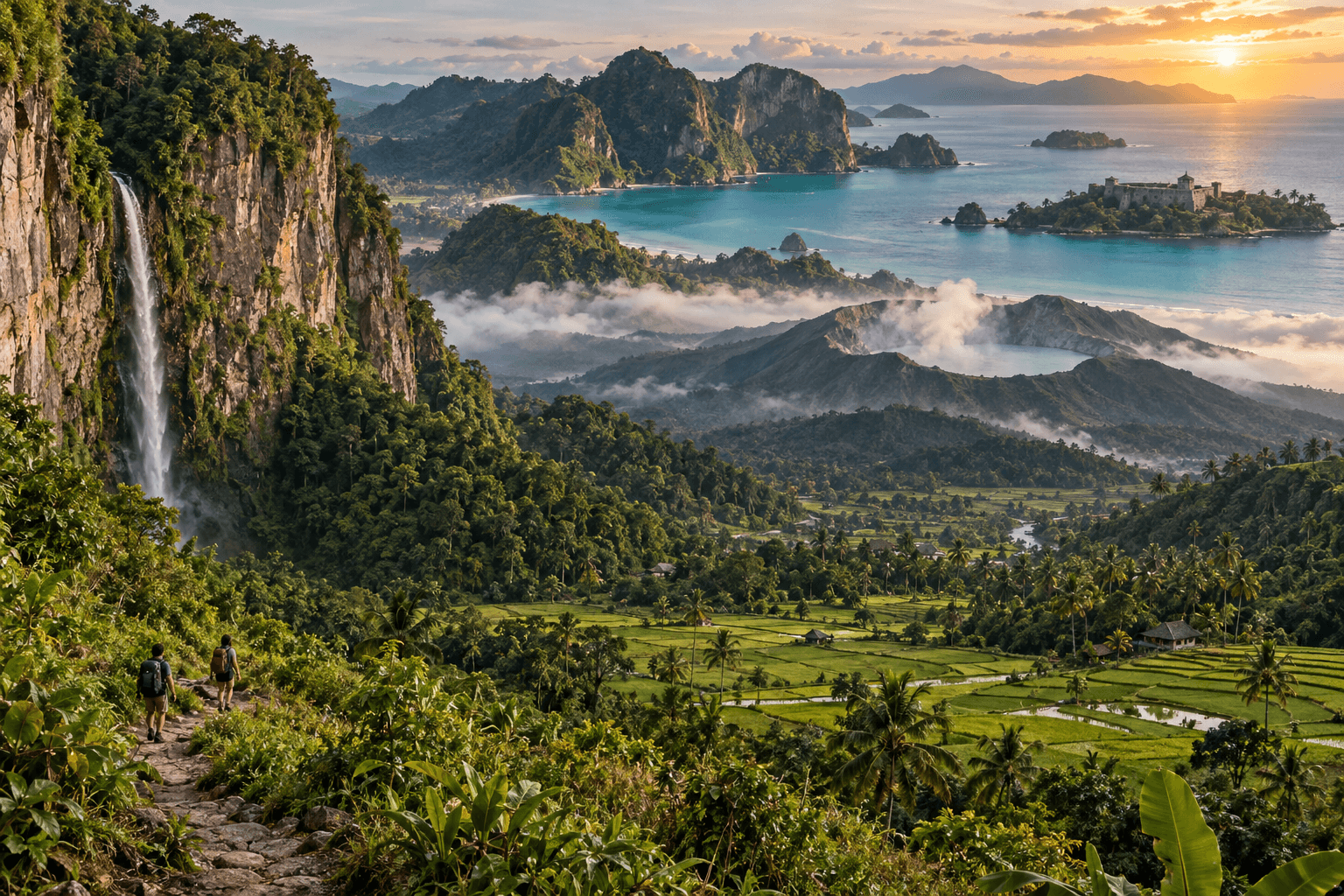
This is not a ranking based on an unnamed traveller poll. It is a practical shortlist of places that reveal different sides of Indonesia: a West Sumatran valley, an East Javan volcano, a Balinese island, a Central Javan highland, and a remote Maluku archipelago.
Harau is the easiest slow-nature stop, Ijen suits a prepared hike, Nusa Penida combines coast and marine activities, Dieng brings geology and early Javanese heritage together, and Banda rewards travellers who can allow for limited transport. Choose by route and travel style rather than trying to collect all five in one holiday.
- Harau Valley: allow 2-3 nights from the West Sumatra route.
- Ijen: use Banyuwangi or Bondowoso as the practical base.
- Nusa Penida: stay overnight for a less compressed itinerary.
- Dieng: base in Dieng or Wonosobo and prepare for cold mornings.
- Banda Islands: add buffer days for transport and weather.
1. Harau Valley, West Sumatra
Harau Valley lies in Lima Puluh Kota Regency, near Payakumbuh and Bukittinggi. Steep rock walls frame rice fields, villages, forest, and seasonal waterfalls, creating a landscape that suits cycling, short walks, photography, and a quiet homestay more than a rushed sightseeing stop.
Waterfall flow, rice-field colour, and morning mist depend on weather and the agricultural cycle. Use marked paths, ask before entering fields, and hire qualified local support for rock climbing rather than treating every cliff as open access. Macaques and other wildlife should be observed without feeding them.
Harau combines naturally with Bukittinggi and other West Sumatra destinations. Road time from Minangkabau International Airport varies with traffic, so keep the arrival day light and confirm the exact homestay location with your host.
2. Kawah Ijen, East Java
Ijen is an active volcanic complex known for its acidic crater lake, sulfur deposits, and blue flames created when sulfur-rich gases ignite. The flames are visible only in darkness and suitable conditions; they are not guaranteed. Claims that the phenomenon exists in exactly two places worldwide are difficult to substantiate and are unnecessary to appreciate it.
Current safety instructions matter more than an old itinerary. Volcanic gas, changing activity, weather, and conservation closures can alter access at short notice. Follow BBKSDA East Java and MAGMA Indonesia, remain on the permitted tourism route, and never descend towards the crater floor when authorities prohibit it. Leave immediately if staff issue an instruction.
The hike starts around Paltuding and requires warm layers, a headlamp for permitted dark-hour starts, water, grip, and enough fitness for a sustained ascent. Treat sulfur miners as workers, not props: give way, do not obstruct their route, and ask before taking a close portrait.
3. Nusa Penida, Bali
Nusa Penida's limestone coast includes Kelingking viewpoint, Broken Beach, Angel's Billabong, Diamond Beach, Atuh Beach, and marine sites such as Manta Point. The west and east coasts are separate day-trip clusters; trying to cover both immediately after a boat arrival often means more road time and less time at each place.
Kelingking is first a cliff viewpoint. The route down is steep, exposed, and unsuitable for many visitors, while the ocean below can be dangerous. Angel's Billabong is affected by waves and tides and should never be treated as a guaranteed swimming pool. Stay behind barriers and follow closures and local warnings.
Manta rays are wild animals, so no operator can promise a sighting. Choose a safety-conscious marine operator that limits crowding, explains conditions, maintains distance, and never encourages touching or chasing wildlife. Sea conditions can cancel a trip even when the sky looks clear.
4. Dieng Plateau, Central Java
Dieng is a volcanic highland shared by Wonosobo and Banjarnegara regencies at roughly 2,000 metres above sea level. Its appeal comes from the combination of crater landscapes, lakes, farms, the Arjuna temple complex, and high viewpoints rather than one single attraction. Indonesia designated the wider Dieng area a national geopark in 2025.
Cold dawns and frost can occur during parts of the dry season, but neither a cloud-free sunrise nor frost is guaranteed. Pack warm layers, check the regional forecast, and allow mist or rain to change the plan. Roads can be winding and busy around weekends and festivals.
Sikidang and other geothermal areas can release hazardous gases. Stay on the official walkway, respect barriers, and check PVMBG or MAGMA information as well as instructions on site. At the temple complex, do not climb structures or treat archaeological stones as seats or props.
5. The Banda Islands, Maluku
Banda Neira is one island within the Banda archipelago and a base for exploring nutmeg landscapes, Fort Belgica, Fort Nassau, colonial-era buildings, exile sites, villages, and surrounding waters. Nutmeg and mace made the islands central to global trade, but that history also includes monopoly, forced removal, and mass violence under Dutch colonial rule. It should not be reduced to a romantic spice story.
Flights and passenger ships are less frequent than services on Indonesia's main tourism corridors and can shift with season, weather, and operations. Build buffer days into both ends of the visit, verify the latest schedule locally, and avoid a tight international connection immediately after leaving Banda.
Diving and snorkelling quality depends on site, season, current, visibility, and operator standards. Use an appropriately certified operator for diving, do not touch coral, and ask how the business manages anchors and waste. On land, a local guide can connect forts and nutmeg groves with Banda communities' own history.
A realistic way to connect the destinations
These places belong to different regional journeys. Harau fits a West Sumatra itinerary; Ijen can connect Banyuwangi with Bali; Nusa Penida is reached from Bali; Dieng pairs with Central Java or Yogyakarta; and Banda requires a dedicated Maluku segment, commonly routed through Ambon.
For a two-week first trip, choose no more than two regions. Ijen and Nusa Penida can form one east-Java-and-Bali route, while Dieng combines more logically with Yogyakarta. Save Harau and Banda for separate journeys so unreliable connections do not consume the entire holiday.
- 7 days: choose one region and explore it well.
- 14 days: combine two adjacent or well-connected regions.
- Banda: add at least one buffer day before a critical onward connection.
- Recheck volcano, marine, and transport conditions shortly before departure.
Travel with the place, not just through it
Use local guides where their knowledge adds safety or context, buy directly from small businesses when practical, refill water responsibly, and keep waste with you until it can be handled properly. Ask before photographing people, farms, religious activity, or working environments.
Conditions across Indonesia change quickly. A responsible itinerary accepts a closed trail, cancelled boat, cloudy sunrise, or absent manta without pressuring staff or wildlife. The destination is still valuable when it does not reproduce the exact image that inspired the trip.
Frequently asked questions
Which of these Indonesian destinations is easiest for a first-time visitor?
Nusa Penida has the most established tourism network, while Dieng and Harau are manageable with advance transport planning. Ijen requires a hike and current safety checks. Banda needs the most schedule flexibility because connections are limited.
Can I visit all five places in one two-week trip?
It is technically possible only with many flights and little margin, but it is not a good itinerary. Choose one or two regions. Ijen and Nusa Penida combine reasonably, while Dieng fits a Central Java and Yogyakarta route.
Is the blue fire at Ijen guaranteed?
No. Visibility depends on darkness, weather, gas conditions, current opening hours, and permitted access. Never enter a restricted area to see it, and verify BBKSDA and MAGMA information before departure.
Can I swim at Kelingking Beach or Angel's Billabong?
Conditions can be dangerous because of steep access, powerful surf, waves, and tides. Treat Kelingking primarily as a viewpoint and follow all barriers and local instructions. Never enter Angel's Billabong when conditions or staff advice make it unsafe.
When can you see frost in Dieng?
Frost may occur on especially cold dry-season mornings, often associated with the middle of the year, but it is weather-dependent and never guaranteed. Check BMKG forecasts and bring warm layers regardless.
How many days do you need in the Banda Islands?
Allow several nights plus buffer time. The exact stay depends on flight or ship schedules, weather, and whether you plan diving or outer-island trips. Avoid placing a critical international departure directly after a Banda connection.
Sources and further reading
We used the following primary consumer resources to review time-sensitive claims in this guide.
Compare options for your trip.
Continue to Traveloka to check current schedules, availability, and final prices for your travel dates.
Affiliate disclosure. This page contains Traveloka affiliate links. We may earn a commission when you book through them, at no additional cost to you. Commercial relationships do not determine our editorial recommendations.