- Confirm the exact stations
- Compare the actual trainset
- Treat seat direction as variable
- Check baggage and fare rules
First confirm that you are booking the right railway
Indonesia does not have one interchangeable national ticket for every train. KAI intercity trains connect many cities across Java and operate separate services in parts of Sumatra. Urban systems, airport trains, local trains, and the Jakarta–Bandung Whoosh high-speed railway use different service structures and may have different booking channels and stations.
Before comparing classes, identify the operator, service name, departure station, arrival station, and whether a transfer is required. A search for Jakarta to Bandung can produce an intercity KAI journey or a Whoosh journey using stations outside the traditional city-centre rail pair; their door-to-door experience is different.
- Write down the complete station names and codes.
- Check the station pin on a map.
- Include feeder or city-transfer time in the comparison.
Choose stations around the itinerary
Large cities can have several stations serving different trains. Jakarta intercity services commonly use Gambir or Pasar Senen; Yogyakarta may involve Yogyakarta or Lempuyangan; Surabaya has Gubeng and Pasarturi; Bandung and Kiaracondong serve different departures. These examples are not interchangeable for every route.
A cheaper train from the wrong station can require a longer, more expensive road transfer. Check morning traffic for an early departure and local transport availability after a late arrival. When connecting onward, make sure both trains use the same station or allow enough time to cross the city.
Class names do not describe every trainset
KAI's core intercity choices include Economy and Executive, with premium products such as Luxury, Panoramic, and Suite Class Compartment on selected services. Business Class still appears on limited services or formations, but it should not be treated as a universal middle option available on every route.
Economy layouts vary widely, from older higher-capacity seating to newer generation coaches with different seat design and orientation. Executive generally offers more space and reclining seats, but outlets, tables, footrests, blankets, meals, and entertainment can depend on the train and trainset. KAI's own service page qualifies several facilities by trainset.
Compare the specific service details shown for your date rather than relying on a generic class description. A newer Economy coach may suit one traveller better than an older premium-labelled product, while a long overnight journey may justify the extra space of Executive or a private premium cabin.
Understand fares and subclass letters
The same travel class can appear at several fare levels or subclass codes. These price buckets mainly control the fare and inventory available for that departure; they do not automatically create a different coach or faster journey. However, never assume that a particular letter is always the cheapest across every class and service.
Compare the live price and attached conditions. Booking earlier often gives more choice, especially around Eid, Christmas, New Year, school holidays, and long weekends, but it does not guarantee the lowest possible fare. Special promotions can have separate routes, travel dates, quotas, and change conditions.
- Compare the same train and class before interpreting a code.
- Do not pay more for a letter without checking what changes.
- Read the live fare conditions before payment.
Choose a seat without relying on false guarantees
A seat near the centre of a coach may reduce door traffic, while an end seat can be closer to a toilet or inter-car door. Yet coach design varies, and the seat map may not show every source of noise. Travelling with a group? Confirm each selected seat before checkout rather than assuming the system placed everyone together.
Seat numbers do not guarantee a forward-facing view for the entire route. A train can reverse direction, the trainset can change, and some Economy layouts have fixed or facing seats while newer coaches use different configurations. If motion sensitivity matters, inspect the available seat map and current service information, but keep a backup plan such as medication advised by a clinician.
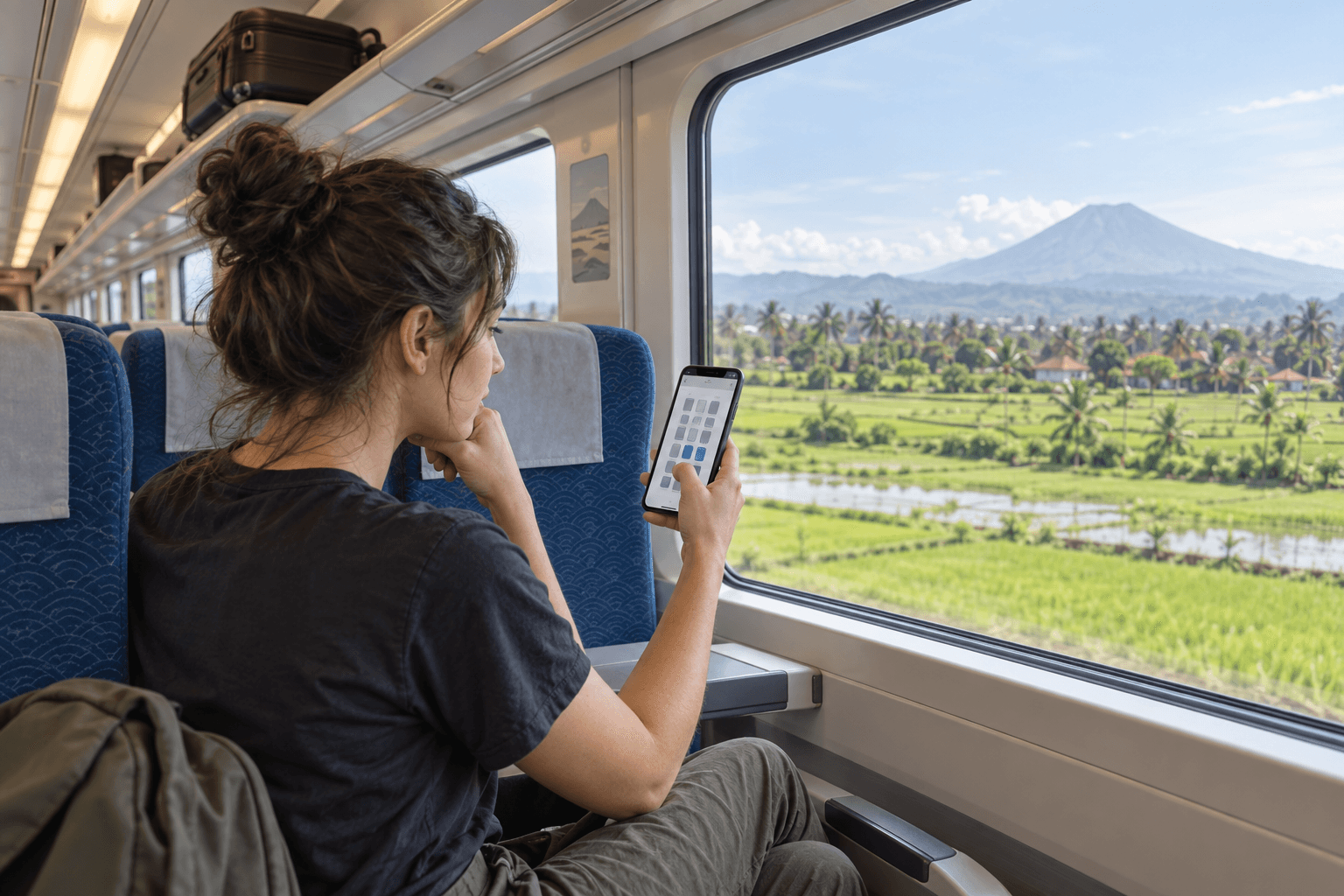
A window seat can still align with a wall or imperfect view, and the most scenic side can change along a route. Choose for comfort and access first; scenery should be a bonus rather than the basis of a rigid seat promise.
Check journey time, arrival hour, and onboard needs
Compare the complete schedule, not just the ticket price. A late-night arrival can make hotel check-in or local transport difficult, while an early departure can require leaving before breakfast or before public transport begins. Build in station access time and arrive early enough for identity and boarding checks.
Food and drinks are sold on many intercity services, but selection and operating hours vary. Carry water and suitable snacks when needed. Dress in layers because air conditioning can feel cool, keep essential medication accessible, and bring a charged device plus an offline copy of the ticket.
Measure baggage before reaching the station
KAI's current intercity terms allow each passenger up to 20 kg of free baggage, with a maximum of four items and total volume up to 100 dm³. The stated maximum outer dimensions are 70 × 48 × 30 cm. Baggage over the included allowance can be charged or require another arrangement under current rules.
Do not plan only around weight: large cases must fit safely in the available racks or designated space and must not block aisles or seats. Keep passports, electronics, medicine, money, and other valuables with you rather than in an unattended case.
Prohibited and restricted items still apply. Unusually large equipment, bicycles, animals, or commercial goods need specific checking in advance; do not assume an airline-style suitcase rule answers every special-item question.
- Weigh all pieces together.
- Count small bags toward the item total.
- Recheck current KAI terms before travelling with special equipment.
Use the exact passenger identity
Foreign passengers should enter the identity number shown in the passport and keep the passenger name consistent with that document. Carry the original matching passport to the station. Indonesian passengers use the identity information required by KAI for their ticket.
Review every passenger before payment because correction options can be limited. The booking contact should use an email address and phone number that remain accessible during the trip, since they may receive confirmation or service information.
Check children, accessibility, and assistance
Do not infer child ticket rules from airlines or foreign railways. Enter the child's correct age and date of birth and read the current KAI conditions for whether a separate seat or fare applies. Families should verify that selected seats are together before paying.
Passengers who need step-free access, boarding assistance, space for a mobility device, or proximity to station facilities should contact KAI before purchase when possible. Accessibility differs by station, platform, trainset, and assistance requirement; a wheelchair symbol or ground-floor map alone may not describe the full journey.
Read change and cancellation rules before payment
A timetable that works today may become expensive to change. Check whether the ticket can be rescheduled or cancelled, the deadline, fee, eligible passenger, refund method, and processing requirements. Current KAI terms apply rules and deductions to eligible changes, so keep the payment method and account available.
Make sure the payment succeeds before its deadline and that a valid booking code or e-ticket appears. Save the confirmation offline. If a third-party platform cannot retrieve the ticket, resolve it before reaching the station rather than assuming a payment receipt is enough to board.
The final pre-payment checklist
Read the order summary from top to bottom: operator, train name and number, date, departure time, stations, passenger identity, class, fare, coach, seats, baggage needs, arrival time, and change conditions. Then confirm the final total and payment deadline.
For a first booking, complete the step-by-step process through Access by KAI, KAI's official website, or an authorised partner. This checklist complements the separate online-booking guide by helping you decide what to select before you press pay.
- Correct route and stations
- Matching passport details
- Suitable trainset and class
- Seats checked for every passenger
- Baggage within the current limit
- Arrival and transfer still workable
- Fare conditions understood
Frequently asked questions
Which train class is best for travelling in Indonesia?
Economy suits budget-focused trips, while Executive generally offers more space and reclining seats. Luxury, Panoramic, and Suite products operate on selected services. Compare the actual trainset and journey length because facilities vary within a class.
What do KAI subclass letters mean?
They identify fare inventory within a travel class and can have different prices. They do not automatically mean a different journey time or coach. Compare the live fare and conditions rather than memorising a supposedly cheapest letter.
How can I choose a forward-facing seat on an Indonesian train?
The seat map may help, but direction cannot always be guaranteed because train orientation, reversals, and trainset changes can affect it. New and older Economy layouts also differ.
How much baggage can I take on a KAI intercity train?
Current KAI intercity terms allow up to 20 kg across no more than four items, with total volume up to 100 dm³ and stated maximum dimensions of 70 × 48 × 30 cm. Check the latest terms before travel.
Do foreign tourists need a passport to book a KAI train?
Foreign passengers should use the identity number in their passport when booking and carry the original matching passport for the journey.
Are all Indonesian train tickets booked in the same app?
No. Access by KAI integrates several KAI Group services, but urban systems and Whoosh can have distinct service and ticket arrangements. Confirm the operator and official channel for the train you intend to use.
Sources and further reading
We used the following primary consumer resources to review time-sensitive claims in this guide.
Compare options for your trip.
Continue to Traveloka to check current schedules, availability, and final prices for your travel dates.
Affiliate disclosure. This page contains Traveloka affiliate links. We may earn a commission when you book through them, at no additional cost to you. Commercial relationships do not determine our editorial recommendations.